Sunday, September 22, 2013

Responding to NCTE and the Evolution of Education


So perhaps I am missing the actual area in which I should be responding too, perhaps there is none and the weekly screencasts we will be doing are just for us to watch and absorb, but either way Dr. Oldakowski's first screen cast on NCTE got me thinking so I decided to do a quick blog about it. NCTE is a treasure trove of information and one I have been a part of since undergrad. I do admit my membership fell off a year or so ago when I didn't receive a placement, but in honor of this little screencast I have renewed my membership ( Dr. O you may need to verify I'm a student.... so... yeah...)

 One thing I was not aware of however was the depth of the back issues we had access to. I thought it would be a really cool idea to have a look at a journal from today and one of the earliest ones they had. So I have chosen two journals one from 2010 and one from 1963. Looking through a few articles I definitely noticed some differences.


This is a screen grab of an article in the 1963 journal. I skimmed through three separate ones and all three without fail followed this same pattern. No figures, no charts or graphs or data. no pictures, just words. Words, Words, Words. Words are nice and all, but I found these articles very hard to get through. Why is that? Is it because I am a of a generation that cannot focus without visual stimuli? I hope that's not the case, and I know its not entirely as I love to read, but it is interesting to compare this to a a screen grab of the an article in 2010.


Here we have pictures, just a few lines above this was a diagram and a chart, but here's the best part... still plenty of words! Loads of em! Long ones, short ones, etc.  I enjoyed actually reading this article. Was it because I was engaged by not only the content but the digital and visual aspects of the article? Perhaps. This little experiment is not entirely pure as the writing style and content of are five decades apart making the recent journals much easier to relate too, but I wonder how I would handle the older articles with a few more images or diagrams?

One other observation I had before I wrap this up, is while the format and media within the article is evolving, albeit at an agonizingly slow pace, the content is the same. Educators 50 years ago face the same problems we face today. Student engagement, social class disparity, student proficiency levels, etc. Very interesting indeed if you ask me.

Wednesday, September 18, 2013

The Language of Persuasion

Still playing ketchup it seems, but I've nearly finished the bottle. I am going to reflect on something we looked at during Week 2. The article we looked at entitled Introduction to Media Literacy had a very extensive section of "The language of Persuasion". This is a very prominent topic when talking about Media Literacy. A traditional text has words, possibly some cover art, and maybe some art inserts. That is typically all the persuasion available. However when dealing with these NML, there is a plethora of new tactics and approaches an author can take to persuade the reader. This can be a good thing, it can also be a bad thing as there is a wide spread epidemic of misinformation. I thought I would take some time and highlight some of the ones I found more interesting and potent.

Jumping into the advanced tactics, as the basic ones are somewhat self explanatory, I think Ad Hominem is very important to address. Especially around election times, these can be seen everywhere.


Attacking the person rather the argument. Digital Literacy allows this to be so much more potent. If those words "Harry Reid The Best Friend An Illegal Alien Ever Had"  were simply read in plain text they would hold little meaning. The connotation would be subjective and in some interpretations it could be seen as even a positive statement. However technology allows us to amplify the message with colors, images, fonts, that persuade the reader to view it a certain way. The Red Text associates Harry Reid directly with Illegal Alien. The color of the text also suggests a negative connotation. The Gray scale scheme of the rest of the ad suggests again a negative image. All of these attributes are only available in this type of medium opening up a whole new avenue of persuasion. 


Another one that is common today is hidden Symbols. These are often seen in advertising in an attempt to influence the subconscious of the reader. For example the american flag juxtaposed against anything makes it seem patriotic and instills a sense of nationalism. Some times symbols are harmless, like this one that blew my mind.

I have been eating Tostitos for years and only recently realized the "tit" in "Tostitos" is two people dipping a chip into a blow of salsa. *Mind Blow SFX* Sometimes however they are more potent and potential harmful.


Here is an obvious juxtaposition of sex and food.The image brings to mind sexual desire and transmits those feelings onto the food. It is in my opinion tasteless and crass. Again this type of literacy is rampant today and would have little effect if viewed in traditional literacy medium. 

Another interesting aspect is the combination of tactics. The message above uses the "Sex Sells" concept along with the "Symbols" concept to really drive its message home.

Digital Literacy allows for a wide array of persuasive powers that can be used for good. Unfortunately the flip side is also true. It is our job as educators to teach students how to see through these types of advertisements and to use these techniques for ethical and moral reasons. 


Wednesday, September 11, 2013

Resurrection


All right, well time to resurrect this blog. Its previous use was a wonderful class I took last spring on multi-cultural literature.  I will admit I am a little late getting around to this. I’ve got a lot to synthesize now though so prepare for a long winded and blown out post. I think I can start by asking myself a question; putting myself on the spot so to speak.

“What does digital literacy mean to you?”

Pretty basic I suppose, but it really spreads its fibers through just about every aspect of my teaching. Digital Literacy, and digital anything really, is about one thing to me. Evolution.


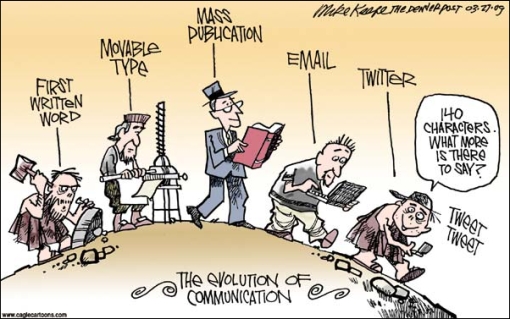
Animals evolve. People evolve. The world evolves. The way we write has evolved as illustrated, comically, above. Even the way we read has evolved. Think about it, the first method people heard and understood literature was orally. Storytellers would wander the land having committed mass tales like “The Iliad” and “The Odyssey” to memory. Even before that however, Hieroglyphics spoke a language that has taken generations to decode. As the march of time went on more people began to read, more mediums began to evolve. I find it somewhat ironic that audio books, arguably the current peak of reading, technologically speaking,  are eerily similar to the storytellers of old. Full circle?

The point is when everything evolves even down to the basics of reading and writing why wouldn’t the methods and skills we use to teach those basics evolve with them? It astonishes me every time I observe a classroom via my clinical requirements or substitute teaching that does little more then put chalk to a black board. Maybe an overhead projector. I understand some schools have limitations with budget, but more often than not I have seen this in schools with the technology literally sitting right there! I walked into a classroom to substitute teach once and saw in the back of the room with a sheet over top of it what appeared to be a rolling white board. Upon further inspection I found out it was a 4,000 dollar Prometheus board. I asked  a student if it had been that way all year, it was mid march at this point, he said “yes, we’ve never used it.” One more example to hammer home my disbelief.

I observed a 7th grade teacher for one of my pre-clinical observations. She spent an entire week teaching the students how to write a personal letter. Before you get ahead of me, there is nothing wrong with students being taught something like writing a letter. While it is a dying tradition, writing a letter facilitates many basic writing and communication skills that students need. My problem came with this conversation at the end of the week. I asked the teacher if she had intentions on taking the students to the computer lab and then teaching them to write an email.  She said to me, and I remember it clearly because I was stunned by her, for lack of a better word negligence, “Email is an informal method of communication that has no place in education.” It is this kind of resistance to technology that blows my mind.


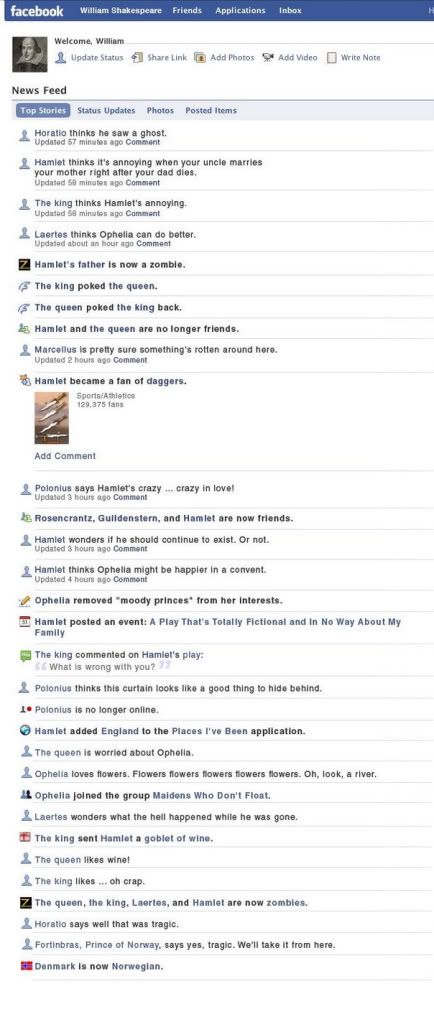
I suppose I have been panning out and away from the question at hand however. What does digital literacy mean to me? (Zoom in to see text)

In a nutshell that is a perfect example of digital literacy. The technology of today meeting the literature of yesterday. Digital literacy is a tactic, a tool to get students engaged and involved in literature they have traditionally found unappealing. One of the interviews within the McVee text stated that technology is a motivator and I think that is right on the money. At the moment digital literacy to me is a way to help the evolution of teaching catch up to the rest of the world.