Wednesday, September 18, 2013

The Language of Persuasion

Still playing ketchup it seems, but I've nearly finished the bottle. I am going to reflect on something we looked at during Week 2. The article we looked at entitled Introduction to Media Literacy had a very extensive section of "The language of Persuasion". This is a very prominent topic when talking about Media Literacy. A traditional text has words, possibly some cover art, and maybe some art inserts. That is typically all the persuasion available. However when dealing with these NML, there is a plethora of new tactics and approaches an author can take to persuade the reader. This can be a good thing, it can also be a bad thing as there is a wide spread epidemic of misinformation. I thought I would take some time and highlight some of the ones I found more interesting and potent.

Jumping into the advanced tactics, as the basic ones are somewhat self explanatory, I think Ad Hominem is very important to address. Especially around election times, these can be seen everywhere.


Attacking the person rather the argument. Digital Literacy allows this to be so much more potent. If those words "Harry Reid The Best Friend An Illegal Alien Ever Had"  were simply read in plain text they would hold little meaning. The connotation would be subjective and in some interpretations it could be seen as even a positive statement. However technology allows us to amplify the message with colors, images, fonts, that persuade the reader to view it a certain way. The Red Text associates Harry Reid directly with Illegal Alien. The color of the text also suggests a negative connotation. The Gray scale scheme of the rest of the ad suggests again a negative image. All of these attributes are only available in this type of medium opening up a whole new avenue of persuasion. 


Another one that is common today is hidden Symbols. These are often seen in advertising in an attempt to influence the subconscious of the reader. For example the american flag juxtaposed against anything makes it seem patriotic and instills a sense of nationalism. Some times symbols are harmless, like this one that blew my mind.

I have been eating Tostitos for years and only recently realized the "tit" in "Tostitos" is two people dipping a chip into a blow of salsa. *Mind Blow SFX* Sometimes however they are more potent and potential harmful.


Here is an obvious juxtaposition of sex and food.The image brings to mind sexual desire and transmits those feelings onto the food. It is in my opinion tasteless and crass. Again this type of literacy is rampant today and would have little effect if viewed in traditional literacy medium. 

Another interesting aspect is the combination of tactics. The message above uses the "Sex Sells" concept along with the "Symbols" concept to really drive its message home.

Digital Literacy allows for a wide array of persuasive powers that can be used for good. Unfortunately the flip side is also true. It is our job as educators to teach students how to see through these types of advertisements and to use these techniques for ethical and moral reasons. 


Wednesday, September 11, 2013

Resurrection


All right, well time to resurrect this blog. Its previous use was a wonderful class I took last spring on multi-cultural literature.  I will admit I am a little late getting around to this. I’ve got a lot to synthesize now though so prepare for a long winded and blown out post. I think I can start by asking myself a question; putting myself on the spot so to speak.

“What does digital literacy mean to you?”

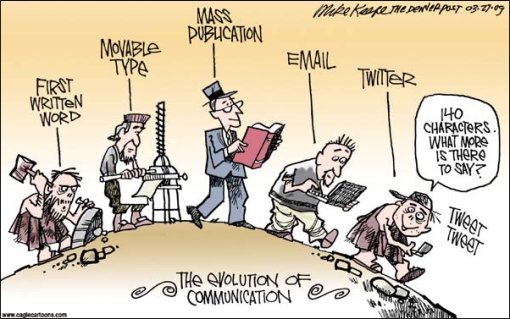
Pretty basic I suppose, but it really spreads its fibers through just about every aspect of my teaching. Digital Literacy, and digital anything really, is about one thing to me. Evolution.


Animals evolve. People evolve. The world evolves. The way we write has evolved as illustrated, comically, above. Even the way we read has evolved. Think about it, the first method people heard and understood literature was orally. Storytellers would wander the land having committed mass tales like “The Iliad” and “The Odyssey” to memory. Even before that however, Hieroglyphics spoke a language that has taken generations to decode. As the march of time went on more people began to read, more mediums began to evolve. I find it somewhat ironic that audio books, arguably the current peak of reading, technologically speaking,  are eerily similar to the storytellers of old. Full circle?

The point is when everything evolves even down to the basics of reading and writing why wouldn’t the methods and skills we use to teach those basics evolve with them? It astonishes me every time I observe a classroom via my clinical requirements or substitute teaching that does little more then put chalk to a black board. Maybe an overhead projector. I understand some schools have limitations with budget, but more often than not I have seen this in schools with the technology literally sitting right there! I walked into a classroom to substitute teach once and saw in the back of the room with a sheet over top of it what appeared to be a rolling white board. Upon further inspection I found out it was a 4,000 dollar Prometheus board. I asked  a student if it had been that way all year, it was mid march at this point, he said “yes, we’ve never used it.” One more example to hammer home my disbelief.

I observed a 7th grade teacher for one of my pre-clinical observations. She spent an entire week teaching the students how to write a personal letter. Before you get ahead of me, there is nothing wrong with students being taught something like writing a letter. While it is a dying tradition, writing a letter facilitates many basic writing and communication skills that students need. My problem came with this conversation at the end of the week. I asked the teacher if she had intentions on taking the students to the computer lab and then teaching them to write an email.  She said to me, and I remember it clearly because I was stunned by her, for lack of a better word negligence, “Email is an informal method of communication that has no place in education.” It is this kind of resistance to technology that blows my mind.


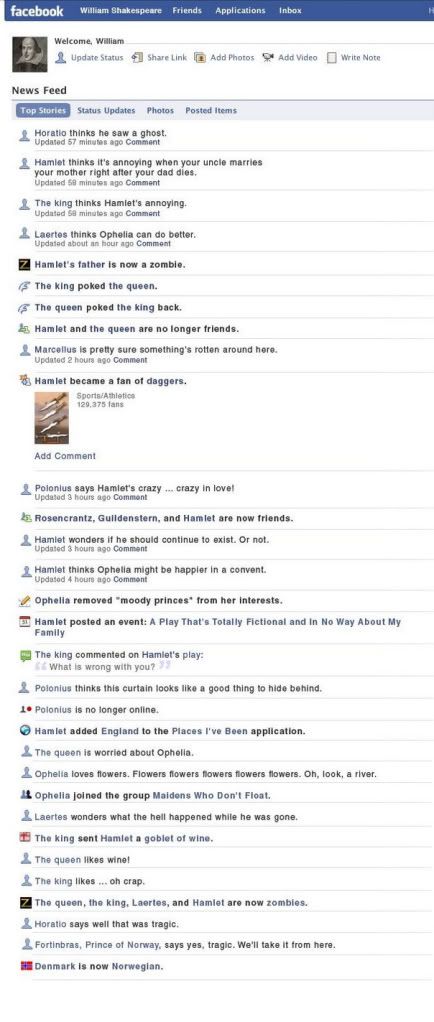
I suppose I have been panning out and away from the question at hand however. What does digital literacy mean to me? (Zoom in to see text)

In a nutshell that is a perfect example of digital literacy. The technology of today meeting the literature of yesterday. Digital literacy is a tactic, a tool to get students engaged and involved in literature they have traditionally found unappealing. One of the interviews within the McVee text stated that technology is a motivator and I think that is right on the money. At the moment digital literacy to me is a way to help the evolution of teaching catch up to the rest of the world.

Sunday, April 14, 2013

Red Glass Book Trailer

Sorry I am a few minutes late!

Been fighting with some technical issues all day. The video was supposed to upload while I was at work but I got home around 1130 to find it had not uploaded at all. So after some technical wrangling without further adieu here it is!


I really enjoyed making this apart from the technical head aches it created for me in the final moments. The novel is a beautiful Spanish American novel about identity and young love. The main character, Sophie, undergoes a beautiful transformation throughout the book wherein she finds her inner strength and courage as well as her confidence to share her feelings for her first love, Angel. I was lucky enough to be engaged to a Spanish minor and she graciously translated and supplied me with the narration.

While the novel has many pulls and storylines, I wanted the trailer to focus on the main one I feel and that is the story of Sophie's transformation from "Sophie la Delicado" or Sophie the Delicate to "Sophie la Fuerte" which means Sophie the Strong. This is a reoccurring theme throughout the novel. There is much more to the story including the plot line of Pablo the young child who after a phone call late at night ends up on Sophie's doorstep, but as I said my main message was to communicate her story.

That's about it, sorry for the 32 minutes you all had to wait to see this, I am sure you were sitting waiting with itching fingers to see it. Enjoy!

Wednesday, March 27, 2013

Stargirl Stories

"She was something we were all afraid to be... ourselves."

Stargirl is perhaps one of the most beautiful, poetic, and inspiring YA Multi-Cultural Lit books I have ever read. I felt that way we I first met it in 2008, I felt the same way when we crossed pages again in 2011, and now in 2013 I feel the same if somehow more inspired by Jerry Spinelli's incredible novel. Every time I read trough it I learn something new, as if it changes and morphs to fit my needs.

My first read helped me to understand who I was and accept my identity as I muddled through those first few uneasy moments of college. The second allowed me to examine the environment of your typical highschool and to prepare myself for the struggle that I and my students will face. Finally this time Stargirl taught me to be patient, and to find joy in the little things life has to offer, like finding spare change or those rare moments in the day when everything is still. I am not professionally where I would like to be, I think any English teacher not in a school is unhappy, but that doesn't mean I need to despair.

The Google Talk myself, Doug, Jerrod, and Carissa, were involved in responding to the novel was perhaps the highlight of this semester. We laughed, enjoyed each others company, but most importantly has a completely unguided, unmoderated, but incredibly deep and fruitful conversation of the novel. I saw It in a light I hadn't seen before, and some else stared talking and it was made new yet again.

All in all an excellent week last week. Steady as she goes!

Tuesday, March 12, 2013

Life, Continuing

Life it seems has taken hold and will not let go. I shall spare you all the details of how oh so glamorous life and cut right to the chase. A simple demonstration will show however the ridiculous nature of my life at the moment, however; I finished Life, After during the middle of the first week we assigned it, and I am now getting around to digesting it.

It was a beautiful novel of hope and inspiration. Beyond the incredible connection I was able to create with it, I am a sucker for themes of young love and heart ache, I really found it resonating with me in a very deep and unexpected way. There was a line, perhaps one of the best closings to a book I have ever experienced, that made me sit back in my chair and really think.

"We all knew there was a Before, which we could never return to, and an After where we had to learn to find joy again."

While my life has had no personal cataclysmic events to speak of, thank goodness, I certainly have found myself stuck as of late, both professionally and personally. As I finished Life, After I sat back in my desk chair and realized, I have been keeping myself in between. My life before was full of joy and sadness. Rather then work through that sadness, I have held on and forbidden myself to move to the next stage, the After. I think it's time to do just that.


Friday, February 22, 2013

Reticulating Splines

It has taken me awhile to get back to this blog I will be honest. My last post ended up being much more cathartic then I expected and I honestly didn't want to look at it for awhile. That part of my life was a hard and arduous journey that I try to forget, but looking back I am not sure why anymore. That journey made me who I am today. I became a teacher to help that student, to inspire that lonely little soul in the harsh realm of high school. Without the torment and abuse I recieved I would never have the well of compassion I possess for my students. I am thankful for that.

I guess to synthesize this with Alexie Sherman, I have gained  valuble perspective. Never lose sight of your roots. They are what make you who are you. Cliche sure, but powerful as well. Arnold left for a strange new world just as terrifying as the one he left, but in the end after all the success he never lost sight of his home, his friends, his family. He was proud of the storys he told. My favorite moment of this comes a few pages before the end, when he lists off the tribes he belongs too. Allow me to bend the laws of copyright infringement slightly to bring that to you.


The honesty and depth of this page makes me realize our past, no matter how painful or regretful it may be makes us who we are today. I am still somewhere deep down the shy, quiet boy who cant say a word with too many S's or T's. And I am proud of him.

Monday, February 11, 2013

The Little Voice Speaks


This past week working through Sherman Alexie’s The absolutely true story of a part-time Indian has dredged up some strange feelings and issues for me. A lot of our discussions have been gearing towards student empathy and personal connections to the text. Alexie’s novel has a plethora of relatable themes and issues that have been and are still prevalent in schools today. All this week I have been talking about ways to get students to open up and connect to these tough issues. I have been offering mediums and strategies to bring these very personal topics into discussion and get meaningful and open responses from my student. I have said things like “By creating the right atmosphere” and “Using journals and quick writes as a gateway.” The entire time however there was a small voice in the back of my head. It began very faintly, and at first I almost didn’t think it was even real, but sure enough as each day of discussion went on that voice got louder, and louder, and louder. I could never make out what it said; the ringing would just dig deeper and deeper into my ear until I finally heard it speak a single word.

BULLSHIT!

Pardon the profanity, but that was what it said, and deep down I knew why. I was bullied in grade school. Massively. I had a debilitating studder, I was overweight, and I was quick to tear up. From 4th through 8th grade I would spend lunch eating in the corner, recess playing behind a tree, and free period being as close to teacher as I could to avoid further torment. The hallways were the worse. They were no mans land and I was a lone allied solider in a field of Nazi Troopers.

The middle of sixth grade I ended up moving to a different school within the district, much like Arnold. I thought this was my chance for a new start. I had thinned out a little, my studder was somewhat under control, and after years of holding in tears through bruised ribs and welted arms I thought I could handle it. And then during my first week I tried to speak up during class. After skipping over the same word nearly a dozen times I heard a few kids snicker and I knew my hell had just started again. We moved one final time the summer before my freshman year of highschool, and I spent the remainder of my education buried in books to avoid further torment.

I am telling all this, because to expect a kid is going to openly connect and share this kind of information in front of most likely the very classmates that are causing this pain is insane and unreal. I would never have done that, and yet were devising plans to make our students do it? Maybe those years have just made a cynic out of me, but I don’t see it happening.

And that happy note will close those week. For those whom miss my usually verbose and frantic writing that had all the cheerful lovingness of a six week old puppy at 3am in the morning never fear, I am sure he will return next week.